Start a project
We'll respond as soon as possible with clear next steps — no obligations.
Case study · Wood & construction
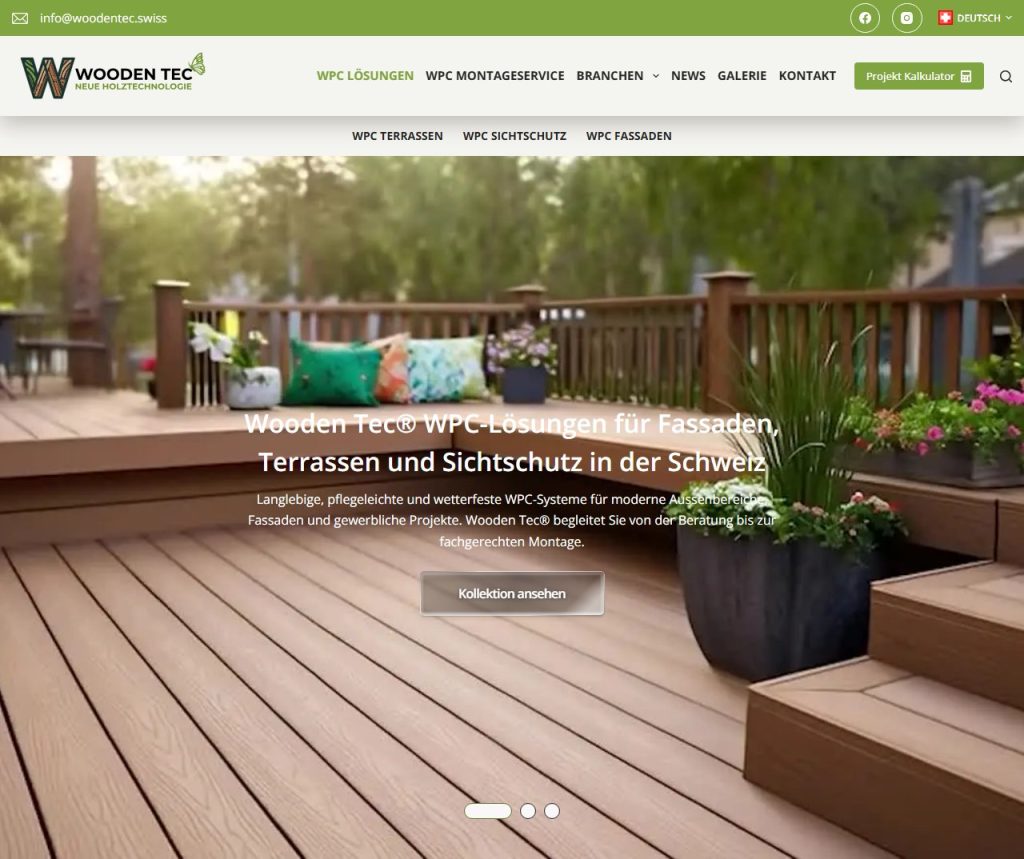
Wooden Tec offers WPC decking, facade systems and privacy screens from Aadorf in Thurgau. We relaunched its running website in four languages — a new industries section, 16 custom blocks, a darker brand green — around its core: our own cost calculator, which turns a product and an area into a price and a numbered request.
The brief
Wooden Tec offers WPC — wood-plastic composite — for outdoor spaces in Switzerland: ECO DECK decking, ECO FACE facade systems and Eco Fence privacy panels, plus an installation service, a free sample box and a partner programme. Its industry pages speak to hotels, restaurants, architects and commercial builders.
The site was already live and indexed in German, English, French and Italian. The relaunch had to add an industries section, bring the blocks in line with the Figma design and a new brand green, and keep the calculator, the forms and the old addresses working.
The challenge
When the relaunch began, Wooden Tec’s website was live and indexed. Everything new — an industries section, 16 blocks, a recolour and a new gallery — had to fit around older content, legacy redirects and our cost calculator, which had to keep pricing and sending requests throughout.
And it is a catalogue, not a shop: prices, variants and requests work without e-commerce, in every language.
Products, categories, industries, forms, calculator strings, block labels and options all exist in de-CH, en, fr-CH and it-CH.
Each product line holds variant rows with a price per m², substructure, installation and colours — and our calculator turns them into a priced request, not an order.
From a backup of the running site to production in about four weeks, with 61 legacy 301 redirects carried along.
Behind the build
One in-house team covered six disciplines. The work started with a backup of the running site and ended four weeks later with a switch of the deploy target. Most of the code landed in the first eleven days; the rest went into content, translations and checks.
What we built
Cost calculator
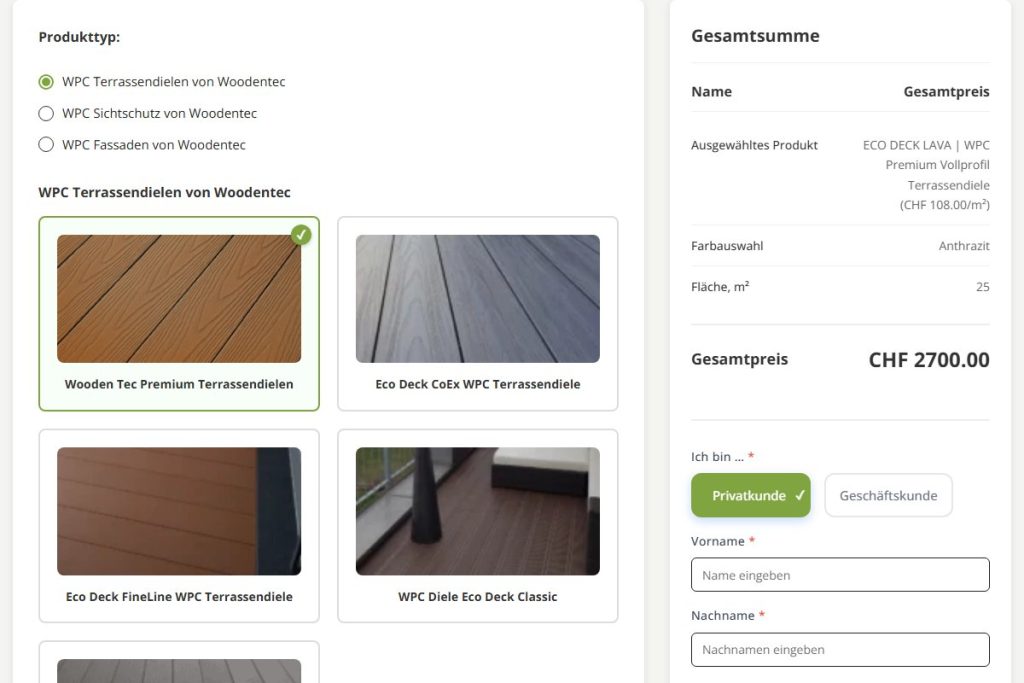
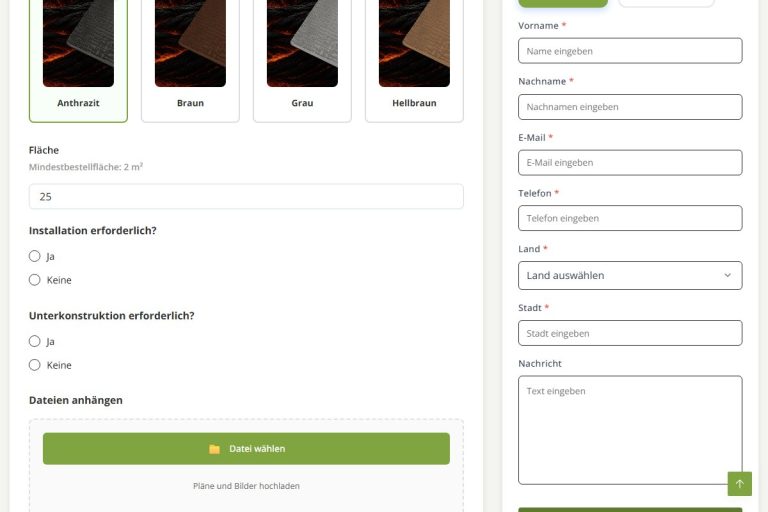
Our own cost calculator guides visitors from product type to colour, installation and substructure. It multiplies the area — or height × length where a category needs it — by the CHF price per m², shows the total at once and sends the configuration as a numbered request with plans and photos.
Industries
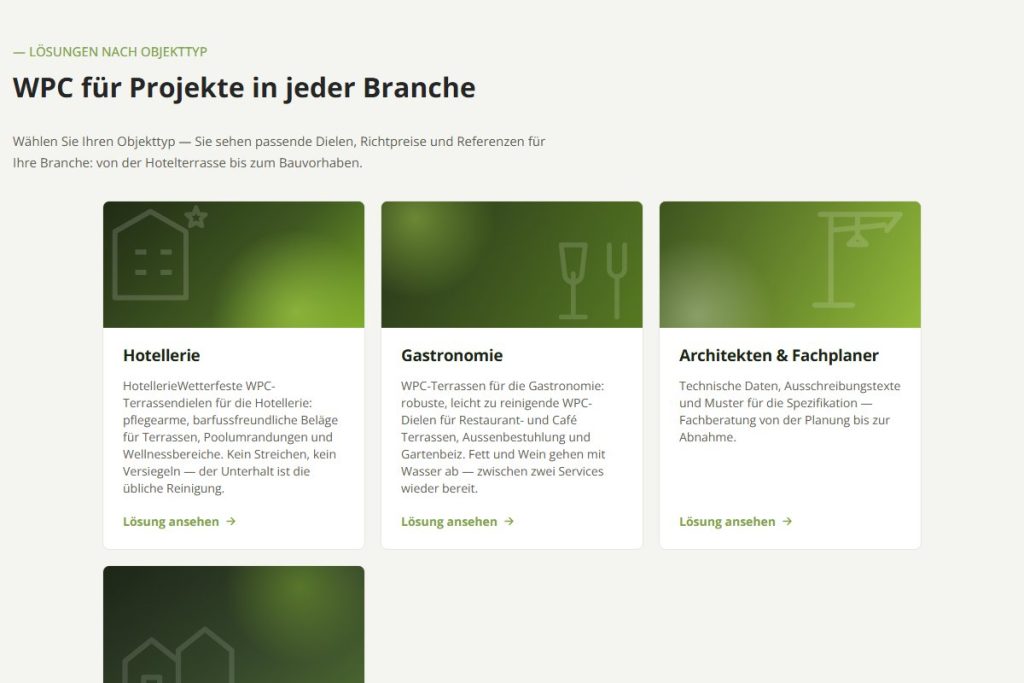
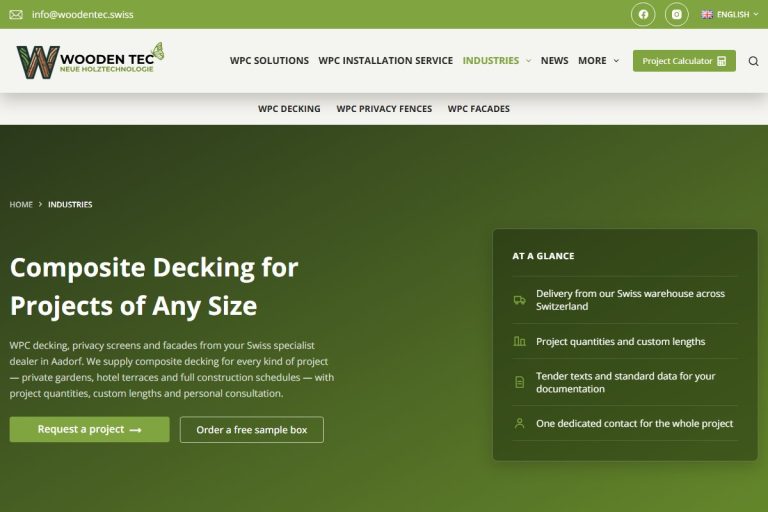
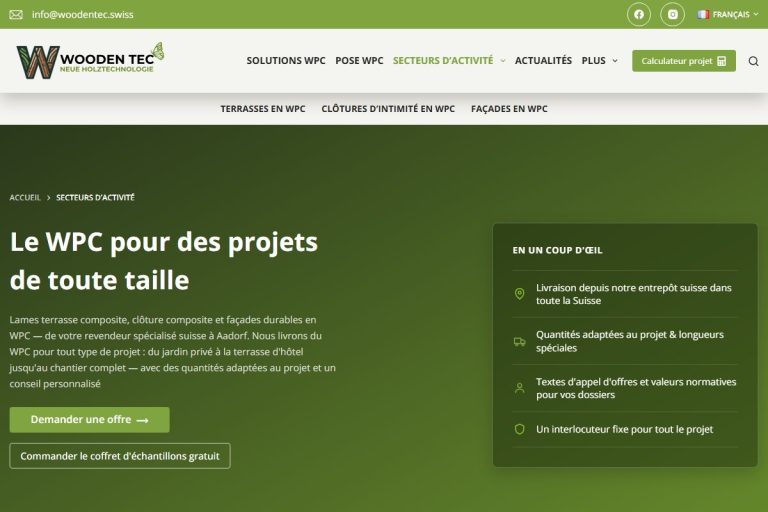
A new post type powers the industries section: an overview page built from blocks in the editor, and a page per industry — hotels, restaurants, architects and planners, commercial construction — with its own hero, request button and card slider. 16 industry pages are live in four languages.
Product pages
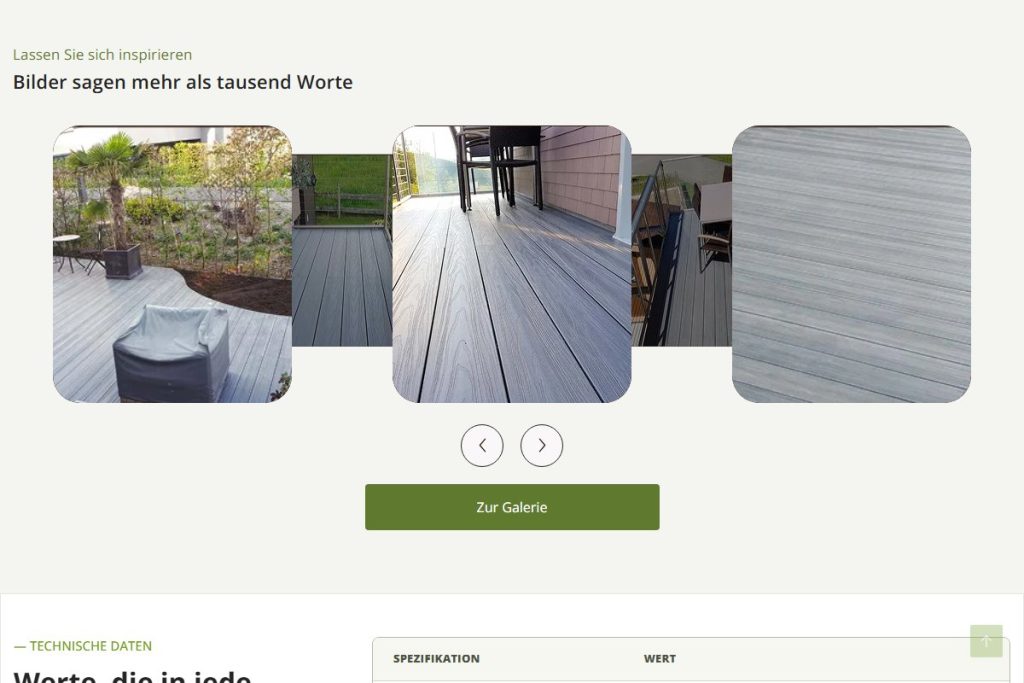
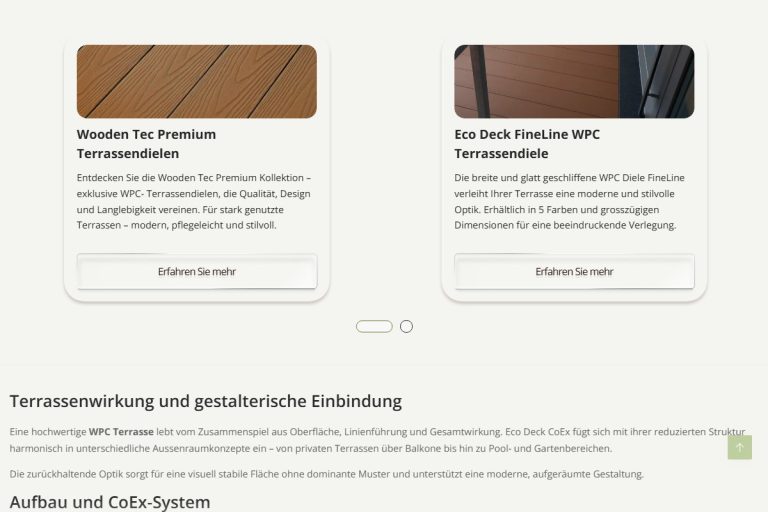
Product line pages are assembled from the new blocks: profile and specifications, advantages, an image slider and technical data with a PDF. Below them, a slider now fills itself with related products from the same category instead of relying on manual picks.
Block library
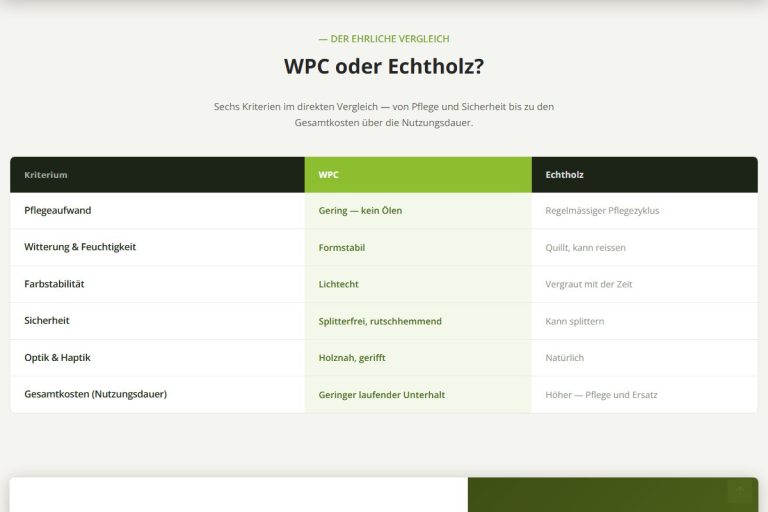
The new block plugin gives editors 16 dynamic blocks in three inserter groups — global, product and industry — from a comparison table and a process timeline to a sample box banner. Colours come from one palette config, labels in five locales.
Gallery
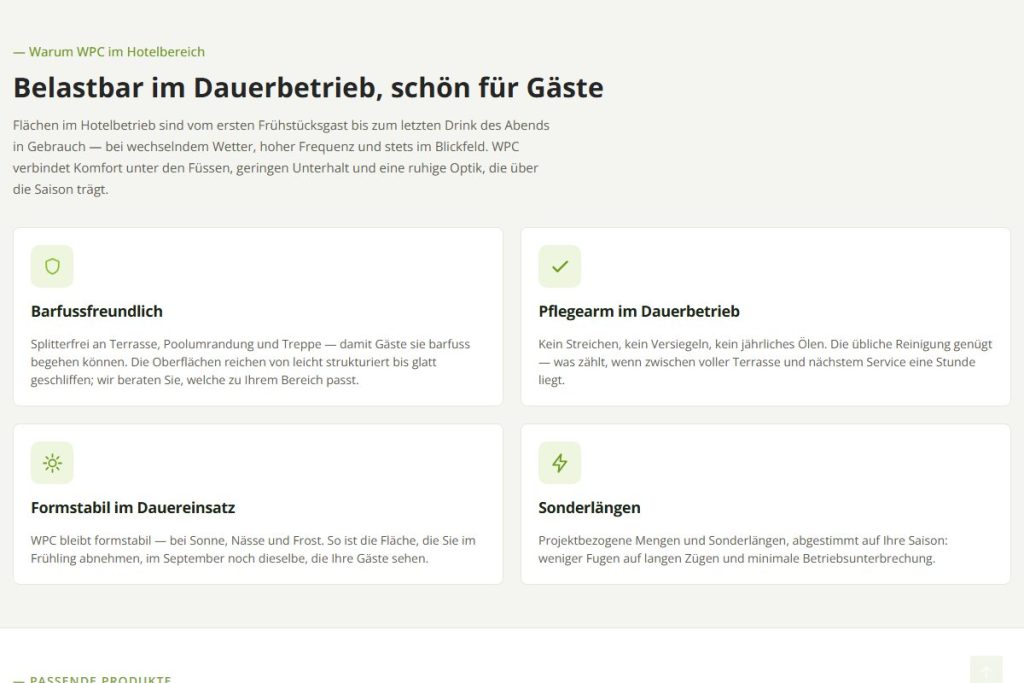
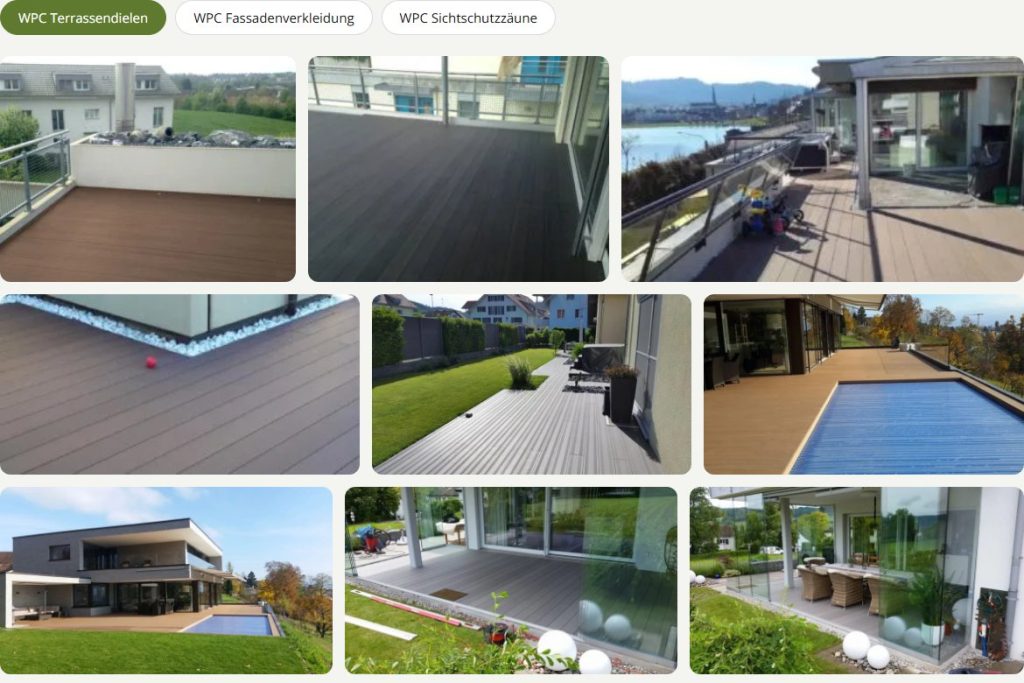
The gallery page used to run on the Modula plugin. Custom code replaced it: one language-neutral image list, tabs for decking, facades and privacy screens, a lightbox with a thumbnail strip and “Mehr laden” — managed on its own admin screen.
Inside the project
Most agencies show you the finished site. We show you how it got there. Open any discipline to see what the team did and what it handed over.
01 / Project management
Work began with a full Duplicator backup of the running site. From there, dev and feature branches went through pull requests in two repositories, GitHub Actions deployed to a staging folder, and on launch day both repositories switched their target to production.
45
merged pull requests in two repositories
101
commits in two repositories
What we did
Handed over Approved scope and requirements → Design
02 / UI/UX design
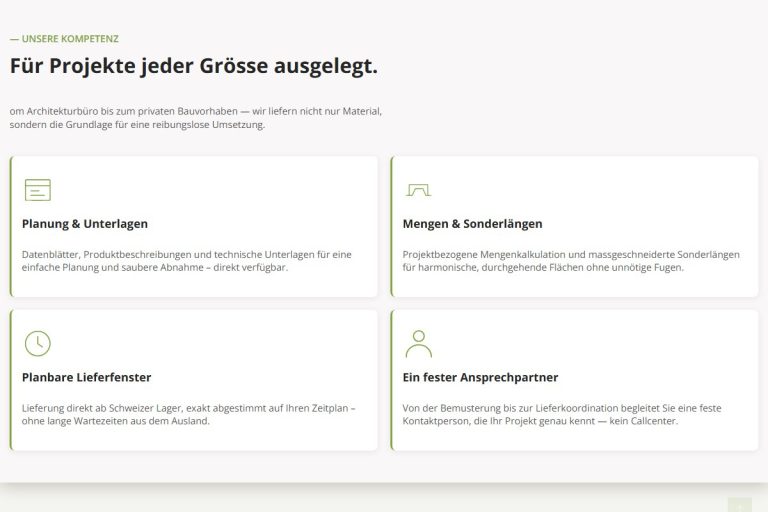
The blocks follow the Figma design, with icons exported from it. During the build the brand green moved to a darker shade across theme, blocks and calculator, and industry pages got a new page hero with card icons — later finished with a brand gradient.
What we did
Artifacts
Handed over Figma designs and a block system → Development
03 / Development
Our cost calculator is a module of its own: a REST endpoint serves the product structure per language from a self-clearing cache, and requests run through an AJAX handler with validation, file upload, a request number and two e-mails. Around it sit 16 dynamic blocks and theme modules for industries, gallery and related products.
16
dynamic Gutenberg blocks
72
calculator texts in four languages
3
inserter groups: global, product, industry
What we did
Artifacts
Handed over Tested build on staging → Content & SEO
04 / Content
Everything new arrived in four languages: industry pages, the industries overview, block labels and the page hero’s call to action. Block strings ship in five locales, and the industries section is live in German, English, French and Italian.
4
languages with their own URLs
16
industry pages across four languages
5
block-editor locales
What we did
Artifacts
Handed over Structured content in the CMS → SEO & GEO
05 / SEO & GEO
The site already had its own hreflang group and hand-built product data, and the relaunch kept both intact. It added to them: an llms.txt rewritten for launch day, the E-E-A-T profile image in post meta and industry landing pages in four languages.
61
legacy 301 redirects carried along
What we did
Handed over Indexed, crawlable site → Launch
06 / Technical support
After the relaunch the team stayed on: in September the page hero swapped its background image for a brand gradient with a darker info card, and changes go out through the same pull-request and deploy pipeline as the build.
What we did
Handed over Ongoing — we stay with the client
The project in numbers
Counted on the live site and in the code of both repositories.
16
dynamic Gutenberg blocks
3
inserter groups for editors
4
languages with their own URLs
16
industry pages across four languages
40
product pages across four languages
5
block-editor locales
72
calculator texts in four languages
45
merged pull requests in two repositories
Below the surface
Visitors see a new green, new industry pages and a new gallery. Underneath sit the backup, the pipeline and the language work that let a running site change in place.
On the first day, before work started, a full Duplicator backup of the running site was taken — a way back at any point.
Both repositories deploy through GitHub Actions; on launch day each moved its target from the staging folder to production.
The Modula gallery gave way to custom code with its own REST endpoint, so one image list serves every language.
The calculator serves its product structure per language from a cache that empties whenever a product, category, image or translation changes.
Every block label and setting ships in de_CH, de_DE, en_GB, fr_CH and it_CH, so editors see the blocks in their own language.
Brand and background palettes for all 16 blocks live in one config file instead of being scattered across them.
On launch day the short llms.txt was rewritten into a full summary of products, languages and services for AI assistants.
61 legacy 301 redirects, the custom hreflang group and the hand-built product schema came through the relaunch intact.
What you can expect
We build for the things that last — a platform that is clearer to navigate, more credible to every visitor and genuinely easier for your team to run and grow.
Clear categories, filters and prices let visitors find the right offer themselves instead of writing to ask where to begin.
A site that looks and reads like the quality behind it — for first-time visitors and long-standing customers alike.
Your team updates products, content and news itself — no developer ticket, no waiting in a queue.
New products, categories and languages slot in as the business expands — without a rebuild.
We agree the goals that matter up front and build toward them together — then stay on as a partner after launch to keep the platform sharp as the business grows.
In their words
The real measure of a project is whether the people who live with it every day would do it again.
The relaunch happened while our site stayed online. Our cost calculator turns enquiries into priced, numbered requests, and we now have a page for every industry in four languages.
Working with
Start a project
We will respond as soon as possible with clear next steps — no obligations.