Your options
WordPress plugin development: two ways to add a feature
If no ready-made plugin covers your process, we develop a new one. If you already use one that can be built on, we extend it. Both routes follow the same rules, so the code stays readable and is built to survive updates.
-
Custom WordPress plugin development
Custom WordPress plugin development is for work your team does by hand because no ready-made plugin fits it. The function then follows your process, and your team runs it in…
-
WordPress plugin customization & extension
WordPress plugin customization is worth having when your plugin can do almost everything and one piece is missing. We add that piece through hooks, the connection points a plugin provides,…
Our approach
Code that fits your processes
Your business needs something no ready-made plugin does, or the plugin you rely on should do more. Either way we write or extend the code: custom Gutenberg blocks (building blocks for the WordPress editor), product finders, price switchers for business and retail customers, cost calculators or shipping rules. Plugins that handle personal data, such as forms or customer accounts, are planned with data protection in mind.
- Discovery
- Your process, understood first
- Interface
- Settings your team understands
- Code
- Readable and documented
- Updates
- Ready for future versions
What we look out for
Three rules for every plugin
-
WordPress conventions first
Where WordPress offers its own connection points (hooks), roles and interfaces, we use them. That keeps the code easier to maintain and easier to hand over to another developer.
-
One job per plugin
Each plugin does one job, and separate features get separate modules. A change in one place then leaves the rest alone.
-
Settings in the admin
Texts, prices or rules your team may want to change sit on a settings page in the backend, the admin area of WordPress. Your team can adjust them later too, without asking a developer.
The thinking behind it
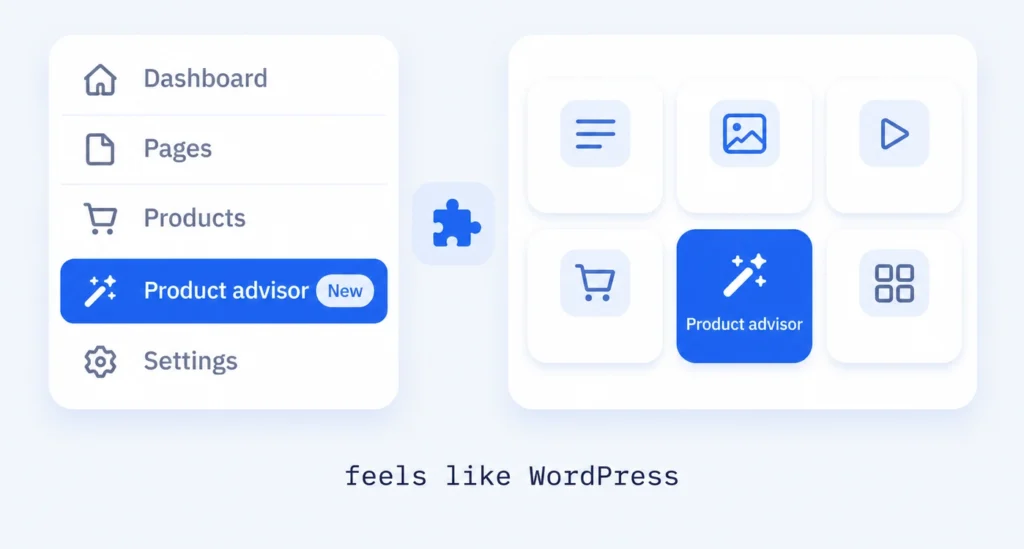
Plugins that feel like WordPress
Your team should not have to learn a new tool every time a feature is added. A good plugin uses the menus, fields and blocks your team already knows and stays out of the way everywhere else.
At Poolroboter.ch (RENIOS Invest AG), a pool and garden shop in Pfungen, four of our own plugins are at work: custom blocks for the pages, a product consultant, an accordion that shows categories as fold-out sections and a translator for legal texts.
Never edit the code of a third-party plugin directly, because the next update overwrites the change. We extend it through hooks or a small add-on plugin, so updates keep running. After launch, our WordPress support keeps WordPress and every plugin up to date.