
What you need
A WordPress landing page with one goal
You want visitors from an ad, an email or a post to do one thing: send a request, make a booking or buy. A landing page is the single web page built for that. We plan and develop these pages in WordPress for a product, an offer or a campaign. For the next campaign you swap the texts and images yourself in the block editor, the editing window of WordPress.
- Wrong destination
- Your ads lead to the homepage
- New product
- A new product needs a page of its own
- Waiting for developers
- Every new campaign page has to go through development
- Quiet inbox
- Clicks come in, requests do not
How it runs
Your landing page, from goal to launch
If you have a landing page built, you are usually working towards a campaign date. So we settle the goal and the offer first, write and develop in parallel and keep the last days free for tracking (measuring what visitors do on the page) and tests. The aim is to have the page ready when the first ad goes out. Never put a page live without a test request through the form, because a form that sends to an old address loses every request of the campaign.
-
Goal & offer
The one action, the audience and the promise of the ad. The headline repeats that promise, so visitors see at once that they are in the right place.
-
Structure & copy
Sections and arguments in the order visitors need them. Each section leads to the same action, and we leave out menus and side links so visitors stay with the offer.
-
Design
The layout in your brand, focused on the call to action. References and answers to the usual doubts sit right beside it, where the decision is made.
-
Development
The page set up in editable WordPress blocks for desktop and mobile.
-
Tracking & tests
Form, tracking and loading time checked on real devices.
-
Launch
The page goes live and is developed further with each round of data.
What we need from you
What you bring before launch
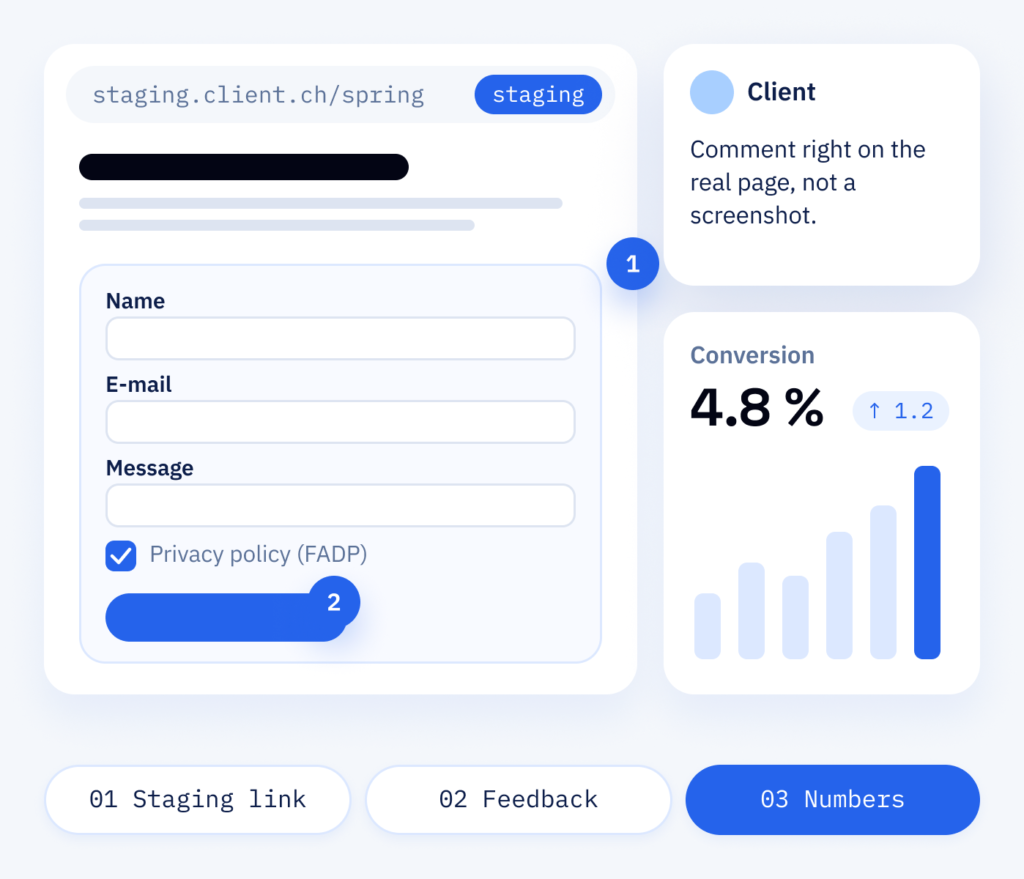
From you we need the offer, the campaign date and, at the end, your sign-off. Early on you get a link to a test copy of the page (staging), so you see everything before visitors do. You comment there on the real page instead of screenshots and approve the final version in one round.
The form asks only for the data the request needs and links to the privacy policy, in line with the Swiss data protection act (FADP).
Because the page lives in your WordPress, it stays after the campaign ends: the next campaign uses its blocks with new texts, and updates run within our WordPress maintenance plan.
- Staging link from the first draft
- Feedback on the real page
- Shared numbers after launch
What you get
A clear next step
A focused page keeps the promise of the ad, answers doubts and shows one next step, so the visitors you pay for find what they came for. Because it is built from blocks, the same page also serves the next campaign with new texts and images.
On the page
- One page built around one action, with the offer clear at a glance
- Compressed images for mobile visitors
- Pages kept in temporary storage (cache), which supports short loading times
- Form and tracking checked with a test request
For the next campaign
- Blocks for future campaigns
- Changes to texts and images in the WordPress editor, without development
- Measurement of form requests, clicks and scroll depth
- Shared numbers as the basis for the next version
Why this works for you
ScaleAble for landing pages
With landing page design we plan the page, the form and the tracking together, so soon after launch you can see which part of the page works.
-
Ready for variants
Headlines, images and calls to action sit in separate blocks, so a variant can be set up and compared without a new page.
-
Measured
We record form requests, clicks and scroll depth in Google Tag Manager, a tool for managing what a website tracks, so you see how visitors use the page.
-
Light on mobile
Compressed WebP images (a space-saving image format), caching and a preloaded main image keep the page light on a mobile connection.
-
Copy and layout
We plan copy and layout on the same page from the first draft, so message and design fit.
Weighing it up
Send your ads to a landing page of their own
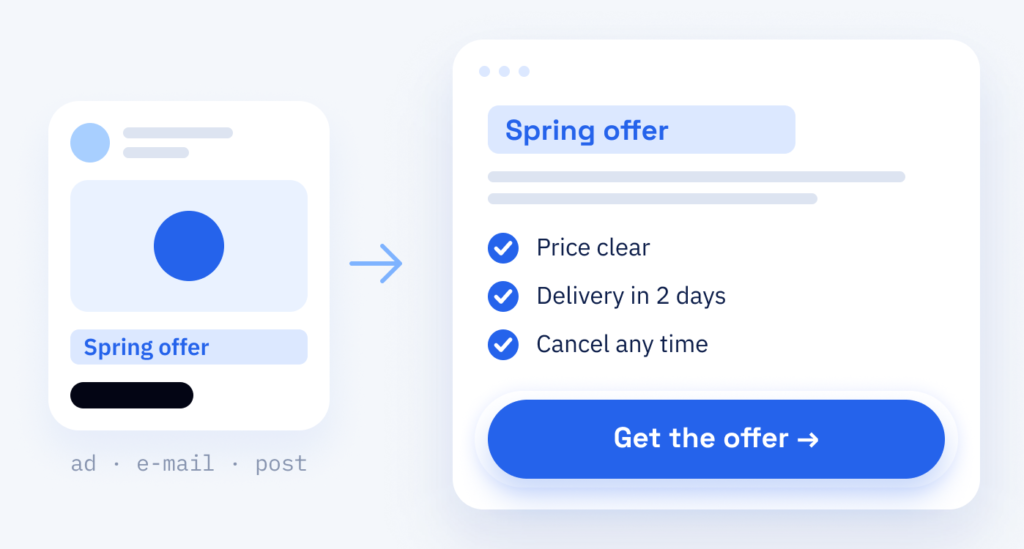
Visitors arrive from an ad, an email or a post with one question in mind. Do not send them to the homepage: there they meet menus, news and other offers, and the answer is several clicks away.
A separate page for each campaign solves that. The headline picks up the ad, the page answers the usual doubts and the one action sits where the decision is made. Have these pages built from blocks rather than developed anew for each campaign, because your team then only swaps texts and images for the next round.
Our Wooden Tec case study shows what this looks like on a larger scale: as of October 2026 there are 16 industry pages in four languages, each with its own top section (hero) and request button.
Cost
What a landing page costs
-
How much goes on the page
The number of sections, the scope of the tracking and whether texts and images already exist. We are happy to show you what your landing page needs for that.
-
The work nobody sees
Nobody sees the tracking or the test request through the form on the finished page. They still belong in the plan, because without them neither requests nor numbers reliably arrive.
-
After the first campaign
Updates run through the maintenance plan. Joint reviews and new variants come on top if you want to develop the page further. For the next campaign you use the same blocks with new content.
After launch
Better variants over time
After launch we read the numbers with you and turn them into the next version of the page. We make small changes directly on the live page. A larger new version goes to the test copy first and live only after your sign-off. Texts come from our copywriters, the analysis from web analytics, both at RankExperts, our brand for online marketing and content.
Part one
Landing page
A focused WordPress page in blocks, light on mobile and ready for campaign traffic.
- Page structure and copy built around one action
- Responsive layout in editable blocks
- Form connected and tested before launch
Part two
Tracking & variants
The same page measured in use and improved step by step.
- Tracking for requests and clicks (conversion events) in Google Tag Manager and in analytics
- Regular reviews of where visitors drop off
- New headline and section variants compared