When it comes up
When the second language sounds foreign
Customers prefer to buy in their own language and from companies that understand their market. If your texts sound foreign or the versions drift apart, people notice. Our translation services cover websites, product descriptions and campaigns in German and English.
- New customers
- You want to reach English- or German-speaking customers
- Stiff texts
- Machine translations sound stiff or wrong
- Drifted apart
- Your language versions are out of sync
- No visitors
- Foreign-language pages bring no visitors
How we go about it
Localisation in a fixed order
Localisation, adapting a translation to its readers, needs order, especially when two languages run in parallel. First we settle the scope and a glossary, the list of your fixed terms. Then we translate what a sentence means and does, adapting idioms, examples and humour to the readers. After that, a German or English speaker reads each version and checks whether it sounds natural to your readers. Finally we adapt the SEO for each language and publish once every version is complete.
-
Scope
Pages, languages and markets, with agreed priorities.
-
Glossary
Key terms and style rules set for each language.
-
Translation
Content translated for meaning, tone and local context.
-
Native review
A native speaker checks style, terms and local fit.
-
SEO adaptation
Keywords, titles and descriptions adapted per market.
-
Publishing
Language versions live, linked and checked.
Your part
Your experts stay part of the review
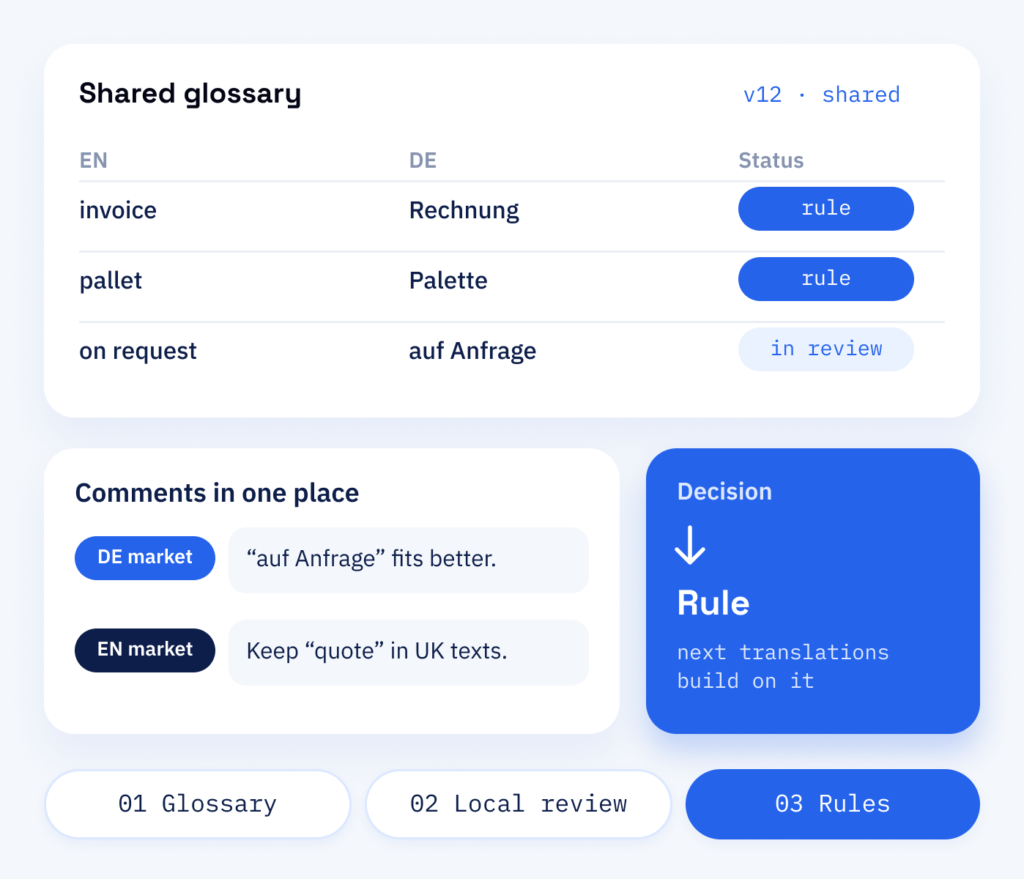
Your colleagues know the product and the customers well. We share the glossary with them, collect their comments and turn every decision into a rule that later translations build on.
Website, shop, posts and documents use the same approved terms, so customers meet one consistent voice in their language.
- A shared glossary for both languages
- Comments from your experts
- Decisions recorded as rules
What changes
Every language as a complete version
Careful localisation removes the small errors that cost credibility and can make each language version a real entry point, in search as well as on the page.
For your texts
- A glossary of your key terms per language
- Translated texts reviewed by native speakers, with the meaning properly carried across
- Search terms (keywords) adapted per language, plus titles and descriptions for the search results (metadata), matched to what your readers search for
- Style notes per language
On your website
- Language versions published and linked
- Translated URLs and hreflang tags, markers that help search engines show the right language
- A language switcher that keeps visitors on the same page
How we work
RankExperts for website translation
RankExperts handles the translation and the search side, while ScaleAble, our brand for design and development, can set up the languages in WordPress with the language plugin Polylang, hreflang and translated URLs. For Wooden Tec (Timberline AG), products, categories, industry pages, forms and calculator texts run in several languages, including German and English, as the Wooden Tec case study shows.
-
Updates stay in sync
When the original changes, we flag the affected pages in both languages, so every version stays current.
-
Native review
A native speaker reads every page before it goes online.
-
Local terms
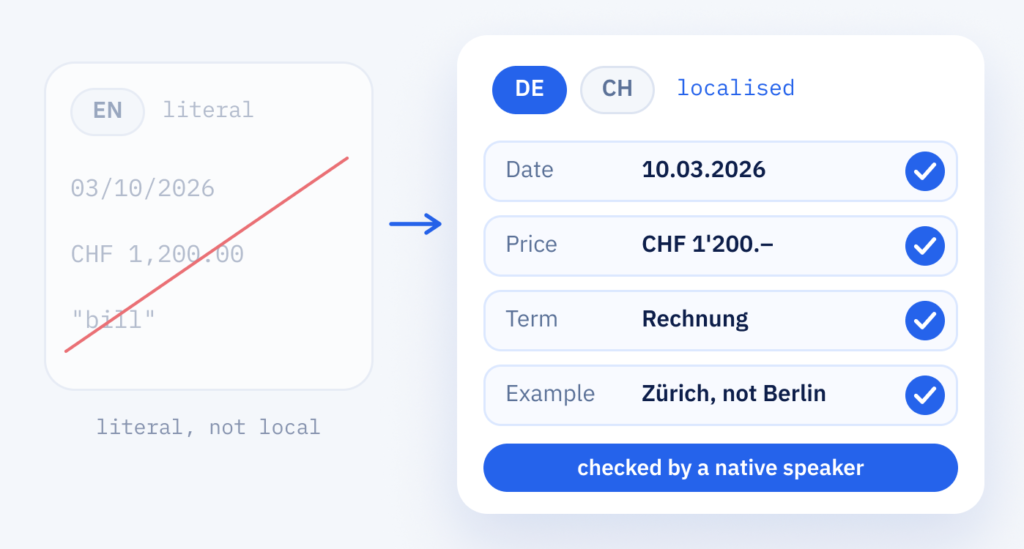
German texts use the terms, formats and quotation marks your customers know from their market.
-
Set up in WordPress
We configure Polylang, hreflang and translated URLs on your website, so each language works like a site of its own.
Three versions
Machine, literal or localised
Localisation adapts a translation to its readers: the right date format, the terms your customers use and examples that make sense locally. Machine versions, by contrast, often sound stiff or wrong.
A literal translation gets most words right, yet the tone often slips: terms sound foreign, examples miss the mark, and German- and English-speaking readers notice within a few lines.
A translation that no native speaker has read does not belong online, because small errors in terms or tone cost credibility with the very readers you want to reach. Someone on the team adapts terms, tone and examples, applies your glossary and checks keywords and metadata before the pages go online.
Cost
Cost of website translation
-
Pages and words
The price depends on the number of pages and words and how much needs local adaptation. We are glad to estimate the effort for your languages.
-
More than the page text
A web page also has menus, buttons, forms, product data, metadata and image texts. Setting up the languages in WordPress also goes into the price if you want us to do it.
-
Later changes
When the original changes, both languages have to follow. What that amounts to depends on how many pages and words change.
WordPress
Translation and WordPress languages together
You can combine translation with multilingual WordPress: we configure Polylang, language switchers and hreflang, so every version is published correctly. If pages change later, we update both languages on request, and updates and tested backups continue in our WordPress maintenance plan.
Part one
Localisation
Texts adapted to the language, conventions and search habits of each market.
- Glossary and style notes per language
- Translation followed by native review
- Keywords researched in each language
Part two
Multilingual WordPress
Each language set up as a full version of your site with Polylang.
- Pages, menus and products linked between German and English
- Translated URLs and hreflang tags
- A language switcher that keeps visitors on the same page